 |
| Examination of a Witch |

Artnautics: /ärtnôtiks/ noun : an area of effect where nothingness hits creativity 2) an unconscious effort to explore the art world. 3) a creativity engine.4) Art and sundry. 5) A mini-Gallery of ART, Beauty, Pop Culture, and Comics (from Merriam-Webster Dictionary)
Friday, May 6, 2016
The Examination of a Witch - T H Matteson
Tompkins Harrison Matteson was an American portrait painter born in Peterboro, New York, in 1813. Matteson studied at the National Academy of Design and was inspired by the works of William Sidney Mount, a contemporary of the Hudson River School. He ran a studio in New York City from 1841 to 1850 and he died in Sherburne, New York, in 1884. His works focused on rural everyday life, historical events and, patriotic and religious figures. His widely known for his depiction of George Washington at Valley Forge (circa 1854), The Spirit That Won the War (circa 1855) and The Spirit of '76 (circa 1845). In the Examination of a Witch (circa 1853), Matteson re-tells an event that possibly occurred during the Salem witch trials in 1692, where Mary Fisher, a young girl, is arrested by Deputy Governor Bellingham of Massachusetts Bay Colony, and forced to disrobe. The deputy tries to ascertain if she is a witch with the Devil's mark upon her. Matteson assists the viewers with describing the event by using the facial expressions of the constables, the direct pointing and fainting of the trial room attendees, to suggest a serious transgression has taken place.(source:http://salem.lib.virginia.edu/intro.html)


Sunday, April 10, 2016
The Sin - Franz Von Stuck
Franz Von Stuck (1863 - 1928) was a German symbolist painter, sculptor, and engraver. His works focused mainly on the use of female nudes to express serious and immediate danger of the subject and viewer. The Symbolist movement or symbolism peaked in Europe between 1886 and 1900, and unlike realism, which was concern with the ordinary: the working class, and gritty street life, symbolism seeks to express greater emotion and states of the mind. In The Sin (circa 1893), von Stuck displays a temptress; a semi-nude female with her face slightly hidden by shadow, embraced by a serpent whose head is positioned to strike and her upper nude body glows with a desire. The use of the snake clearly points to the fall of eden when the serpent tempts Eve to eat from the tree of wisdom, and with her face slightly darken tends to symbolize an importance of body instead of mind. Franz von Stuck crafts the emotion of lust, desire with foreboding. The Sin visually informs the viewer that her body comes with a payment of one's mortality.

 |
| The Sin circa 1893 |

Monday, September 7, 2015
Campbell's Soup Cans - Andy Warhol
Andy Warhol (1928 - 1987) was an American commercial illustrator that sparked artistic expression in the realm of pop art. He used multiple art forms such as filmmaking, performance art, video installations, and various media types like photography, printmaking, sculpture, film, and music to critically push the boundaries of what is fine art and commercial illustration. His first successful meager of fine art and illustration expression can be embraced in his "Campbell's Soup Cans" which was finished in 1962. Each can is hand-painted using a synthetic polymer paint and thirty-two canvases.


"Though Campbell’s Soup Cans resembles the mass-produced, printed advertisements by which Warhol was inspired, it is hand-painted, while the fleur de lys pattern ringing each can’s bottom edge is hand-stamped. In this work, he mimicked the repetition and uniformity of advertising by carefully reproducing the same image across each individual canvas. He varied only the label on the front of each can, distinguishing them by their variety. Warhol said of Campbell’s Soup, “I used to drink it. I used to have the same lunch every day, for 20 years, I guess, the same thing over and over again.” (MoMA website)
British artist Richard Hamilton described pop art as"popular, transient, expendable, low cost, mass-produced, young, witty, sexy, gimmicky, glamorous, big business." As Warhol himself put it, "Once you 'got' pop, you could never see a sign the same way again. And once you thought pop, you could never see America the same way again. (bio. website)
Sunday, May 3, 2015
The Course of Empire: Desolation - Thomas Cole
Thomas Cole (1801 - 1848) was an American landscape artist and was the creative energy for the Hudson River School. The Hudson River School was a 19th century American art movement that was focused on the aesthetic and emotional aspects of nature. The School weaved the concepts of Europe's romanticism to create a wonderment for America's wild, and unexplored territory. The Hudson River School started in upper New York State around the Catskill, and Adirondack mountains. The members included Albert Bierstadt, Jasper Francis Cropsey, Thomas Hill, John Frederick Kensett, Asher Brown Durand, William Hart, Sanford Robinson Gifford, and Thomas Cole. Cole's imaginative visualizations of natural landscapes powered the romanticism in American landscape art in the 19th century. In his The Course of the Empire series, which include the title paintings, The Savage Lands (1833 -1836), The Arcadian or Pastoral State (1833-1836), The Consummation of Empire (1836), Destruction (1836), Desolation (1836), Cole expresses a divine and noble presence in his works. The open landscape with the horizon unbroken, the bluish hue of the sunlight and moonlight, the sizing of human figures with reference to environment, the induced feeling of weather that is experience, are the precise elements that induce an emotional reaction to the work. With other Hudson River School artist expressing similar effects, "shimmering water and hazy skies, lit by diffused light" lead to a modern label for these type of works as Luminist. "In Luminist works, man is sufficiently at peace with Nature that he can be reintegrated into the landscape without danger of starting a Course of Empire." (from "a river runs through it" by John Dorfman in Feb 2015 issue Art and Antiques)


Sunday, November 9, 2014
The Battle of Trafalgar - Joseph Mallord William Turner
Joseph Mallord William Turner (1775 – 1851) was an English Romantic landscape painter, water-colorist, and printmaker. He is regarded as the artist who elevated landscape/marine painting thru the uncanny, and noble ability of arranging colors to offer a feel and stimulating effect of luminosity and volume. In his works, The Battle of Trafalgar c 1824, Fisherman at Sea c 1796, and in Mount Vesuvius in Eruption, c 1817, Turner fascinates his audience with a great command of color to capture moments either historical or current, in nature where things appear to be dire for the subject has he faces the wraths of god either thru war, storm or volcano. This ability was developed with academic inquiry and travel to Italy and Sweden. In 1817 , Turner again crossed to the Continent, this time to explore the Lowlands and the Rhineland. In 1819, he traveled to Italy where he stayed for six months before returning laden with over two thousand sketches, studies and rough watercolors. Angoh, Stéphanie (2013-03-15). Turner (Kindle Locations 179-181). Parkstone International. Kindle Edition.
He is commonly known as "the painter of light" for a distinct and well deserved reason.
Turner's sense of the vivacity of color was enormously stimulated by his visit to Italy in 1819, understandable, given that the color sensibilities of most northern European artists are transformed by their contact with Italian light and color. Angoh, Stéphanie (2013-03-15). Turner (Kindle Locations 291-293). Parkstone International. Kindle Edition.


Monday, September 1, 2014
The Great Red Dragon and the Woman Clothed with the Sun - William Blake
William Blake (November 1757 – August 1827) was an English painter, poet and printmaker with an original artistic expression during the Romantic period. He remained unknown during his productive career, but became a crucial figure during the later stages of his life. "Blake stands alone in the history of British art; his paintings, prints and poetry evoke a private world of religious, mythic and philosophical themes of searing originality." (Tsaneva, Maria (2013-12-26). William Blake: 100 Masterpieces (Annotated Masterpieces Book 72) (Kindle Locations 142-144). Maria Tsaneva. Kindle Edition.
"He believed that the visible world of the senses is an unreal envelope behind which the spiritual reality is concealed and set himself the impossible task of creating a visual symbolism for the expression of his spiritual visions". Tsaneva, Maria (2013-12-26). William Blake: 100 Masterpieces (Annotated Masterpieces Book 72) (Kindle Locations 36-38). Maria Tsaneva. Kindle Edition.
The Great Red Dragon Paintings(circa 1805-1810) are a series of watercolor paintings that offer some insight into William Blake's visionary romantic style. It was during they early 1800s that Blake was commissioned to create over a hundred paintings intended to illustrate books of the Bible. These paintings depict 'The Great Red Dragon' in various scenes from the Book of Revelation.
(3)"And there appeared another wonder in heaven; and behold a great red dragon, having seven heads and ten horns, and seven crowns upon his heads.(4) And his tail drew the third part of the stars of heaven, and did cast them to the earth: and the dragon stood before the woman which was ready to be delivered, for to devour her child as soon as it was born." Rev 12:3-4 KJV
The verse refers to John the Apostle's descriptive vision in the Book of Revelations of the Great Red Dragon, Satan, trying to seize or devour the soon-to-be born Redeemer from his mother. The figure known as the Woman Clothed with the Sun is the Virgin Mary and she is a symbol for Israel and for the Church. Blake's threatening Dragon displays powerful musculature as well as its monstrous tail, wings, and horned heads.
"He believed that the visible world of the senses is an unreal envelope behind which the spiritual reality is concealed and set himself the impossible task of creating a visual symbolism for the expression of his spiritual visions". Tsaneva, Maria (2013-12-26). William Blake: 100 Masterpieces (Annotated Masterpieces Book 72) (Kindle Locations 36-38). Maria Tsaneva. Kindle Edition.
The Great Red Dragon Paintings(circa 1805-1810) are a series of watercolor paintings that offer some insight into William Blake's visionary romantic style. It was during they early 1800s that Blake was commissioned to create over a hundred paintings intended to illustrate books of the Bible. These paintings depict 'The Great Red Dragon' in various scenes from the Book of Revelation.
(3)"And there appeared another wonder in heaven; and behold a great red dragon, having seven heads and ten horns, and seven crowns upon his heads.(4) And his tail drew the third part of the stars of heaven, and did cast them to the earth: and the dragon stood before the woman which was ready to be delivered, for to devour her child as soon as it was born." Rev 12:3-4 KJV
The verse refers to John the Apostle's descriptive vision in the Book of Revelations of the Great Red Dragon, Satan, trying to seize or devour the soon-to-be born Redeemer from his mother. The figure known as the Woman Clothed with the Sun is the Virgin Mary and she is a symbol for Israel and for the Church. Blake's threatening Dragon displays powerful musculature as well as its monstrous tail, wings, and horned heads.
 |
| The Great Red Dragon and the Woman Clothed in the Sun |
 |
| The Great Red Dragon and the Woman Clothed with the Sun |
 |
| The Great Red Dragon and the Beast from the Sea |
 |
| The Number of the Beast is 666 |
Monday, June 9, 2014
Witches' Sabbath (The Great He-Goat) - Francisco Goya
Francisco Goya (1746 - 1828) was court painter to the Spanish Crown and a major influence in the use of the Romantic approach. The Romantic style or Romanticism was an artistic, literary, and intellectual movement in the 18th Century that used intense emotion such as apprehension, horror, and awe when confronting the sublime(in nature). While employed by the Spanish Crown, Goya painted portraits of Joseph Bonaparte, Charles IV of Spain, and documented the Peninsular war in a series of prints known as the Desastres de la Guerra (Disasters of War)c 1810-1820. The Peninsular War was a military conflict with Great Britain and Spain against France for control of the Iberian Peninsula. Through his works he became a commentator and chronicler of his era. The subversive imaginative element in his art, as well as his bold handling of paint, provided a model for the work of artists of later generations, notably Manet, Picasso and Francis Bacon.(from Wikipedia)
In his painting, Witches' Sabbath c 1798 (oil on canvas), Goya confronts Spain's' onset of superstition and corruption prevalent in the rural parts of the country. In the work, he displays a group women (young and old), witches, with one holding a child, and the other a corpse, surrounding a goat with large horns under a night sky with a crescent moon and bats. Some of the women are presenting a child to the Devil as a rite of initiation. The skeletons of two children and a three infant corpses dangling from a spike are horror inducing, it implies the goat, the Devil, feeds physically and spiritually upon the infants and children. Goya displays witchcraft as being a mockery to the Roman Catholicism and this scene of superstition is said to have taken place in the rural parts of Spain and Goya, as a member of the court, wanted to make a persuasive statement regarding this type of falsehood.
Goya revisits this notion in The Black Paintings: Witches' Sabbath c 1821-23 (mural), where the goat, in black, is presented again as the Devil, and he sits in front of a group of woman as if he is speaking. In both paintings, the Romantic style derives its intensity from the horrifying appearance of the "goat", the witches, and the infant corpses, and leads the audience into the need to act and stop such a bizarre falsehood from occurring.


In his painting, Witches' Sabbath c 1798 (oil on canvas), Goya confronts Spain's' onset of superstition and corruption prevalent in the rural parts of the country. In the work, he displays a group women (young and old), witches, with one holding a child, and the other a corpse, surrounding a goat with large horns under a night sky with a crescent moon and bats. Some of the women are presenting a child to the Devil as a rite of initiation. The skeletons of two children and a three infant corpses dangling from a spike are horror inducing, it implies the goat, the Devil, feeds physically and spiritually upon the infants and children. Goya displays witchcraft as being a mockery to the Roman Catholicism and this scene of superstition is said to have taken place in the rural parts of Spain and Goya, as a member of the court, wanted to make a persuasive statement regarding this type of falsehood.
Goya revisits this notion in The Black Paintings: Witches' Sabbath c 1821-23 (mural), where the goat, in black, is presented again as the Devil, and he sits in front of a group of woman as if he is speaking. In both paintings, the Romantic style derives its intensity from the horrifying appearance of the "goat", the witches, and the infant corpses, and leads the audience into the need to act and stop such a bizarre falsehood from occurring.
Monday, April 28, 2014
The Fall of the Damned by Peter Paul Reubens
Peter Paul Reubens (1577 - 1640) was a prolific Flemish painter with a majority of his subjects being mostly religious and mythological with some portraits and landscapes; his works exhibit a very strong adherence to the Baroque artistic style. The baroque style, in art, uses over exaggerated motion, and clear interpreted detail to produce drama, tension, and exuberance, and grandeur(Wikipedia). Also, the use of dramatic lighting and dark(chiaroscuro) is used to influence the expressed tension and drama. This style as expressed by Reubens, is clearly seen in the Fall of the Damned(The Fall of the Rebel Angels) circa 1620.
In the Fall of the Damned, at the top of the painting, the Archangel Michael is flowing into a beam of light shining downward, and is forcing the rebel angels down out of heaven. As the light streams downward, a pillar of bodies forms showing rebel angels pulling other souls down with them. Women are being shown in various phases of pleasure and torture after giving into sin, and men's flesh are being pulled off. At the bottom, the painting becomes darker and the souls are more deformed and grotesque. It depicts parts of the Book of Revelation, 12:7-9, "Then war broke out in heaven; Michael and his angels battled against the dragon. The dragon and its angels fought back, but they did not prevail and there was no longer any place for them in heaven. The huge dragon, the ancient serpent, who is called the Devil and Satan, who deceived the whole world, was thrown down to earth, and its angels were thrown down with it."
The main appeal of the work is the amount of life one can sense emanating from the painting. The one lone solitary angel forces the mass of fallen souls downward in to the pit. The change of color from light to a scarlet red then to dark, creates a flow and motion that the senses can follow. "The real content of the artist's paintings, whether religious or secular, is the purposeful humans will that makes its own way through a solitary combat with the universe. It enlivens all that is around it, and subordinates all parts of the work to the expression of this basic idea." Varshavskaya, Maria; Yegorova, Xenia (2014-03-10). Peter Paul Rubens (Best of...) (Kindle Location 392). Parkstone International. Kindle Edition.

In the Fall of the Damned, at the top of the painting, the Archangel Michael is flowing into a beam of light shining downward, and is forcing the rebel angels down out of heaven. As the light streams downward, a pillar of bodies forms showing rebel angels pulling other souls down with them. Women are being shown in various phases of pleasure and torture after giving into sin, and men's flesh are being pulled off. At the bottom, the painting becomes darker and the souls are more deformed and grotesque. It depicts parts of the Book of Revelation, 12:7-9, "Then war broke out in heaven; Michael and his angels battled against the dragon. The dragon and its angels fought back, but they did not prevail and there was no longer any place for them in heaven. The huge dragon, the ancient serpent, who is called the Devil and Satan, who deceived the whole world, was thrown down to earth, and its angels were thrown down with it."
The main appeal of the work is the amount of life one can sense emanating from the painting. The one lone solitary angel forces the mass of fallen souls downward in to the pit. The change of color from light to a scarlet red then to dark, creates a flow and motion that the senses can follow. "The real content of the artist's paintings, whether religious or secular, is the purposeful humans will that makes its own way through a solitary combat with the universe. It enlivens all that is around it, and subordinates all parts of the work to the expression of this basic idea." Varshavskaya, Maria; Yegorova, Xenia (2014-03-10). Peter Paul Rubens (Best of...) (Kindle Location 392). Parkstone International. Kindle Edition.
 |
| Fall of the Damned |
 |
| Women, who have given in to sin, are being pulled away by rebel angels |
Saturday, March 1, 2014
The Little Street by Johannes Vermeer
Johannes Vermeer (1632 - 1675) was a Dutch painter that captured the quite and hidden lives around the town of Delft, Netherlands, his home town. The subjects for the majority of his paintings were female workers in various settings like rooms, inns, brothels, and kitchens. There was nothing extraordinary about Vermeer's choice for certain paintings but what makes each piece stands out is the amount detail, color, and realistic presentation with expressed irregularities. This quality of style can be evidenced in The Milkmaid (c. 1658) and The Little Street (c. 1658).
In The Milkmaid, a woman is pouring milk into a ceramic bowl with a basket of baked bread and pieces of pulled apart bread near the bowl. The circular bread in the bowl is pitted and dented. One can see the white centers and brown crest of the pulled apart bread. The milk is shown falling into the bowl. The woman's focus on the pouring is clearly expressed with sleeves rolled up, with two hands handling the pitcher, a daily chore. The color of each object in the painting seems natural with a real illusion of being real with weight.

In The Little Street, the painting shows an everyday quite scene in Delft with two women working and a child playing in the street. But what stands out, is the red bricks with greyish cement crusting between, the white wash with some browning in various areas, the street with irregular lines, and the natural coloring of the working women. The painting wills the mind to believe that this is an actual polaroid snap shot.

Sources:
VERMEER, JOHANNES (2012-02-05). Complete Works of Johannes Vermeer (Masters of Art) (Kindle Location 448). Delphi Classics. Kindle Edition.
In The Milkmaid, a woman is pouring milk into a ceramic bowl with a basket of baked bread and pieces of pulled apart bread near the bowl. The circular bread in the bowl is pitted and dented. One can see the white centers and brown crest of the pulled apart bread. The milk is shown falling into the bowl. The woman's focus on the pouring is clearly expressed with sleeves rolled up, with two hands handling the pitcher, a daily chore. The color of each object in the painting seems natural with a real illusion of being real with weight.
In The Little Street, the painting shows an everyday quite scene in Delft with two women working and a child playing in the street. But what stands out, is the red bricks with greyish cement crusting between, the white wash with some browning in various areas, the street with irregular lines, and the natural coloring of the working women. The painting wills the mind to believe that this is an actual polaroid snap shot.
Sources:
VERMEER, JOHANNES (2012-02-05). Complete Works of Johannes Vermeer (Masters of Art) (Kindle Location 448). Delphi Classics. Kindle Edition.
Wednesday, December 25, 2013
The Seven Acts of Mercy by Caravaggio
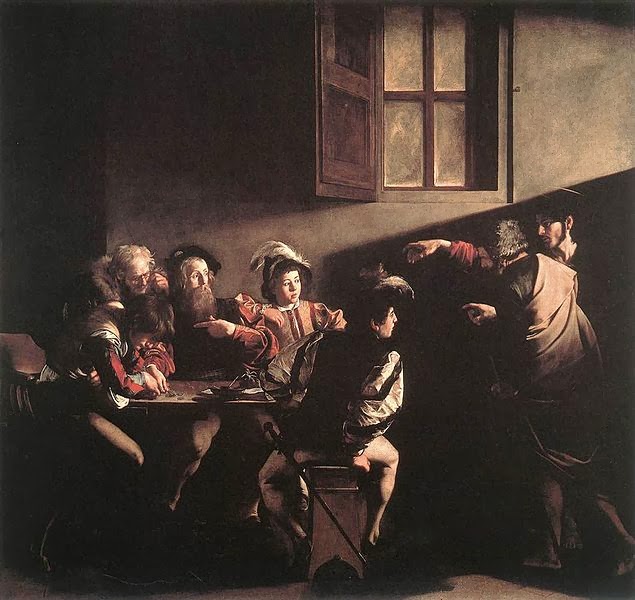
Caravaggio (1571-1610) was an Italian painter with a unique and successful artistic approach of subject matter that encompass both naturalism(realistic presentation) and chiaroscuro (light-dark contrasting) styles. The convergence of the two styles can be seen in The Calling of Saint Matthew (1599-1600) and also in The Seven Acts of Mercy (1607) causing an actual feel of presence from the subject matter in each painting. In the Calling of Saint Mathew, which describes Jesus asking Matthew to become one of his disciples (Matthew 9:9), each element (window, table, and tax collectors) are presented in a truthfully way and appear real. Also the use of dark areas, and light areas combined to create the effect of real objects using space (volume). The beam of light, seems to shine on the faces at the table and cast a shadow with the shudder on the window. In The Seven Acts of Mercy, Caravaggio combines all seven acts into one presentation. The seven acts of mercy are:
1. Bury the dead; In the background, two men carry a dead man (of whom only the feet are visible).
2 and 3. Visit the imprisoned, and feed the hungry; On the right, a woman visits an imprisoned man and gives him milk from her breast. This image alludes to the classical story of Roman Charity.
4. Shelter the homeless; A pilgrim (third from left, as identified by the shell in his hat) asks an innkeeper (at far left) for shelter.
5. Clothe the naked; St. Martin of Tours, fourth from the left, has torn his robe in half and given it to the naked beggar in the foreground, recalling the saint's popular legend.
6. Visit the sick; St. Martin greets and comforts the beggar who is a cripple.
7. Refresh the thirsty; Samson (second from the left) drinks water from the jawbone of an ass. (Source - Wikipedia)
The Seven Acts of Mercy, with Caravaggio directing what we "see", seem to come to life and offer a sense of faith and believability. Again, characters are drawn in a realistic style with color, and size and in addition, with dark-light contrast to create a natural/real setting. The source of lighting appears to come from the left side of the painting, which is evidenced by the shadow cast by the angels wings onto the right of building(opposite side of the painting). Its shines from left to right. This is accomplished by either leaving certain areas untouched on the canvas and adding/editing media on the canvas. The angel's arm reaching down, is surrounding by heavily dark painted section. The contrast causes a perceived "lighting" effect and causes the subject matter to display an inferred volume.

1. Bury the dead; In the background, two men carry a dead man (of whom only the feet are visible).
2 and 3. Visit the imprisoned, and feed the hungry; On the right, a woman visits an imprisoned man and gives him milk from her breast. This image alludes to the classical story of Roman Charity.
4. Shelter the homeless; A pilgrim (third from left, as identified by the shell in his hat) asks an innkeeper (at far left) for shelter.
5. Clothe the naked; St. Martin of Tours, fourth from the left, has torn his robe in half and given it to the naked beggar in the foreground, recalling the saint's popular legend.
6. Visit the sick; St. Martin greets and comforts the beggar who is a cripple.
7. Refresh the thirsty; Samson (second from the left) drinks water from the jawbone of an ass. (Source - Wikipedia)
The Seven Acts of Mercy, with Caravaggio directing what we "see", seem to come to life and offer a sense of faith and believability. Again, characters are drawn in a realistic style with color, and size and in addition, with dark-light contrast to create a natural/real setting. The source of lighting appears to come from the left side of the painting, which is evidenced by the shadow cast by the angels wings onto the right of building(opposite side of the painting). Its shines from left to right. This is accomplished by either leaving certain areas untouched on the canvas and adding/editing media on the canvas. The angel's arm reaching down, is surrounding by heavily dark painted section. The contrast causes a perceived "lighting" effect and causes the subject matter to display an inferred volume.


Friday, May 31, 2013
Staute of Liberty by Frederic-Auguste Bartholdi
Frederic-Auguste Bartholdi (2 August 1834 – 4 October 1904) was a French sculptor widely known for designing and shaping the Statue of Liberty and works of Marquis de Lafayette and George Washington. The Statue of Liberty, Liberty Enlightening the World, was completed/dedicated at Liberty Island, New York Harbor in 1886. It is made of hammered sheet copper that is attached to an iron skeleton. It stands 151 feet tall with a granite pedestal. As an installation with artistic expression, the Statute of Liberty is Bartholdi attempt to create a physical embodiment of liberty. Liberty is defined by Merriam-Webster dictionary as meaning "the quality or state of being free; the power to do as one pleases; freedom from arbitrary control; the positive enjoyment of various social, political, or economic rights and privileges; and the power of choice".
Bartholdi is able to express the spirit of liberty in several ways. First, the figure is posed as stepping forward with a set of broken shackles around both feet. This offers a strong visual clue that the figure is opposing slavery and political oppression. Secondly, the statue is holding a torch with rays of light from her crown while holding a tablet with the date of Declaration of Independence. One widely known quotation in the Declaration of Independence is: "We hold these truths to be self-evident, that all men are created equal, that they are endowed by their Creator with certain unalienable Rights, that among these are Life, Liberty and the pursuit of Happiness." Lastly, the figure is female. During the 1800s, the people of France overthrew the last Bourbon monarch, Charles X, and Louis-Phillipe I Duke of Orleans. The event is known as the French Revolution of 1830, the July Revolution which inspired Eugene Delacroix, a French painter, to create Liberty Leading the People circa 1830. The painting shows a goddess figure leading people over dead corpses while holding the French flag. Delacroix's female figure remains as a symbol of French Revolution and a strong icon of freedom in general as shown further thru Bartholdi's Statue of Liberty.


Bartholdi is able to express the spirit of liberty in several ways. First, the figure is posed as stepping forward with a set of broken shackles around both feet. This offers a strong visual clue that the figure is opposing slavery and political oppression. Secondly, the statue is holding a torch with rays of light from her crown while holding a tablet with the date of Declaration of Independence. One widely known quotation in the Declaration of Independence is: "We hold these truths to be self-evident, that all men are created equal, that they are endowed by their Creator with certain unalienable Rights, that among these are Life, Liberty and the pursuit of Happiness." Lastly, the figure is female. During the 1800s, the people of France overthrew the last Bourbon monarch, Charles X, and Louis-Phillipe I Duke of Orleans. The event is known as the French Revolution of 1830, the July Revolution which inspired Eugene Delacroix, a French painter, to create Liberty Leading the People circa 1830. The painting shows a goddess figure leading people over dead corpses while holding the French flag. Delacroix's female figure remains as a symbol of French Revolution and a strong icon of freedom in general as shown further thru Bartholdi's Statue of Liberty.

Sources:
Durante, Dianne L. (2012-04-20). The Statue of Liberty: Timeless Art, Political Hot Topic (Forgotten Delights:New York Sculpture) (Kindle Location 91). www.ForgottenDelights.com. Kindle Edition.
Sunday, April 14, 2013
The Creation of Man by Michelangelo
Michelangelo Buonarotti (1475-1564) was an Italian painter, architect, and sculptor. Similar to Leonardo da Vinci, he also displayed an expertise in several fields of science and the arts. Widely known for this work, the PIETÀ, a sculpture of Christ after the crucifixion in the arms of his mother Mary, and the Final Judgment, which depicts the Second Coming of Jesus, and the Creation of Man. Both the Final Judgment and the Creation of Man are located in the Sistine Chapel, the Pope's residence at the Vatican City. In 1508, the Pope, Julius II commissioned Michelangelo to adorn the chapel with illustrated stories from the Bible, book of Genesis. The work was completed in 1512.
The Creation of Man(Adam) was created using a painting technique called fresco which involves using water based pigments laid directly on to newly placed plaster or gypsum. The painting is conceptually based on a passage in Genesis 1:27, "So God created man in His own image; in the image of God He created him; male and female He created them." Upon reading the passage, any reader would conceptualize a image of God carving into a slab of earth to create Adam. But it seems Michelangelo has taken the concept of man's creation a step further. "Michelangelo takes these words, and expresses, in his own way, the supreme creative moment when "man became a living soul" (Hurll, Estelle, Kindle Location 646). Like da Vinci, Michelangelo places the subject in action. This is shown with the use of gestures, God's extended finger toward Adam.

Sources:
Hurll, Estelle M. (Estelle May) (2011-03-30). Michelangelo A Collection Of Fifteen Pictures And A Portrait Of The Master, With Introduction And Interpretation (Kindle Locations 646-647). Kindle Edition.
Symonds, John Addington (2012-05-12). The Life of Michelangelo Buonarroti. Kindle Edition.
The Creation of Man(Adam) was created using a painting technique called fresco which involves using water based pigments laid directly on to newly placed plaster or gypsum. The painting is conceptually based on a passage in Genesis 1:27, "So God created man in His own image; in the image of God He created him; male and female He created them." Upon reading the passage, any reader would conceptualize a image of God carving into a slab of earth to create Adam. But it seems Michelangelo has taken the concept of man's creation a step further. "Michelangelo takes these words, and expresses, in his own way, the supreme creative moment when "man became a living soul" (Hurll, Estelle, Kindle Location 646). Like da Vinci, Michelangelo places the subject in action. This is shown with the use of gestures, God's extended finger toward Adam.
Sources:
Hurll, Estelle M. (Estelle May) (2011-03-30). Michelangelo A Collection Of Fifteen Pictures And A Portrait Of The Master, With Introduction And Interpretation (Kindle Locations 646-647). Kindle Edition.
Symonds, John Addington (2012-05-12). The Life of Michelangelo Buonarroti. Kindle Edition.
Tuesday, March 26, 2013
The Last Supper by da Vinci
Leonardo da Vinci (April 15, 1452 – May 2, 1519) was an Italian painter, inventor, and illustrator. A Renaissance man, he displayed insight and expertise in several sciences such as botany, anatomy, engineering, and architecture. His widely known for his Mona Lisa, the Vitruvian Man and the Last Supper. Circa 1495, Ludovico Sforza, Duke of Milan commissioned Leonardo da Vinci to complete a painting for the refectory of the Church and Dominican Convent of Santa Maria della Grazie in Milan, Italy. The Last Supper is 4.6 by 8.8 meters (roughly 15 by 29 feet). Leonardo used tempera gesso over a ground to paint the work. Tempera gesso involves using white paint mixture consisting of a binder mixed with chalk, gypsum, pigment, and oil painted over wood or a Masonite material. The mixture dries quickly and the oil adheres the pigment to the wall.
In the first four books of the Gospel, which consist of Matthew, Mark, Luke and John, the bible reports that at their final gathering before the crucifixion, Jesus and the Apostles, enjoyed a supper and he revels he will be betrayed by one of them. The entire dramatic event becomes one of the main source of Christian faith, the Eucharist or Holy communion, where believers re-enact the last supper as an expression of faith and of obedience to Christ.
Leonardo da Vinci captures the drama and enlightenment of Jesus final gathering with the Last Supper. Leonardo takes a realistic approach with his subjects: All are drawn slightly oversized compared to real life dimensions. Jesus, as the main subject, is balanced as the center of the painting. This is conveyed in the number of disciples to his right and left; and with the windows behind him; and the line of the walls and the table. Further, each disciple is drawn in the act of conversing, arguing and discussing with hand gestures and turned heads. Leonardo's insight into the art of individuals conversing is done beautifully and expressed the drama fully in the Last Supper.


Sources:
King, Ross (2012-10-30). Leonardo and the Last Supper (p. 54). Bloomsbury Publishing Plc. Kindle Edition.
Kirof, Blago (2013-01-31). Leonardo da Vinci Paintings: Annotated (Kindle Locations 40-41). Kindle Edition.
Da Vinci, Leonardo (2012-02-14). Leonardo Da Vinci's Collection (Illustrated): The Notebooks of Leonardo Da Vinci (Volume 1 And Volume 2), Thoughts On Art And Life (Kindle Locations 422-423). Kindle Edition.
In the first four books of the Gospel, which consist of Matthew, Mark, Luke and John, the bible reports that at their final gathering before the crucifixion, Jesus and the Apostles, enjoyed a supper and he revels he will be betrayed by one of them. The entire dramatic event becomes one of the main source of Christian faith, the Eucharist or Holy communion, where believers re-enact the last supper as an expression of faith and of obedience to Christ.
Leonardo da Vinci captures the drama and enlightenment of Jesus final gathering with the Last Supper. Leonardo takes a realistic approach with his subjects: All are drawn slightly oversized compared to real life dimensions. Jesus, as the main subject, is balanced as the center of the painting. This is conveyed in the number of disciples to his right and left; and with the windows behind him; and the line of the walls and the table. Further, each disciple is drawn in the act of conversing, arguing and discussing with hand gestures and turned heads. Leonardo's insight into the art of individuals conversing is done beautifully and expressed the drama fully in the Last Supper.
Sources:
King, Ross (2012-10-30). Leonardo and the Last Supper (p. 54). Bloomsbury Publishing Plc. Kindle Edition.
Kirof, Blago (2013-01-31). Leonardo da Vinci Paintings: Annotated (Kindle Locations 40-41). Kindle Edition.
Da Vinci, Leonardo (2012-02-14). Leonardo Da Vinci's Collection (Illustrated): The Notebooks of Leonardo Da Vinci (Volume 1 And Volume 2), Thoughts On Art And Life (Kindle Locations 422-423). Kindle Edition.
Friday, October 19, 2012
Automat by Edward Hopper
Edward Hopper (1882–1967) was a American realism painter, mostly known for his still-life type paintings and illustrations of American culture. Realism is the attempt to portray subject matter with a photographic precision. Normally, there is nothing exotic or supernatural about realistic painters works. Only the daily mundane barrage of life is drawn and expressed. For the bulk of Hopper's works, the most evident feeling or emotion emanating from his paintings is the constant loneliness. The lone figure displaying no action but a moment that can be described as a deep sigh brought on from trying to outwit loneliness. One of his better known paintings, Automat (c. 1927), shows an alone woman dressed attractively as if she is waiting for someone or just having a cup of coffee alone. Some evidence of what the artist is trying to express can be noticed in the position of the opposite chair, that it is tucked in and not slanted out as if someone had been sitting there. Also, the reflection of the automat 's ceiling lights with the absence of anything else being viewed in the painting seems to imply a state of being alone and uneasiness. When compared with Van Gogh's style, there are no swirls of colors to convey emotion or to reveal an hidden meaning, its seems overly straightforward (illustrated) and realistic setting. Hopper's pattern of displaying common scenes with a singular person being alone seems to be a criticism of an inherent loneliness of everyday life.
Hopper's preoccupation with loneliness is evident in Eleven AM c. 1926 and Gayle on the F Train c. 1971.
 |
| Automat c. 1927 |
 |
| Eleven AM c.1926 |
 |
| Gayle on the F Train |
Saturday, June 30, 2012
The Scream by Edvard Munch
Edvard Munch (1863 – 1944) was a Norwegian symbolist painter. He is well known for his psychologically charged paintings that displayed a singular intense emotion. He most recognized work, The Scream, actively describes a wavy dark figure with a pale face walking along a bridge that oversees a body of water. The intense feeling of horror, or shock emitting from the figure is immediately evident. The eyes and facial expression with hands clasping the sides of his face forms a strong symbol of real horror. The expression of emotion is created by Munch thru the use of line. The wavy form of the main figure contrasted with the straight line of the bridge and distant figures behind him vividly infers something that is only sensed by the wavy figure. The two figures on the walkway are drawn with straight lines, and are expressed as real elements. In addition, notice how the walkway is drawn straight to lead the viewer into the painting. The sky is expressed with wavy lines and unnatural color. The audience gets the feeling the expressed emotion is infectious with way the wavy line moves into the sea near the figure when contrasted with the walkway and the two figures.


Thursday, May 3, 2012
The Bather by Edgar Degas
Edgar Degas (1834–1917) was a French impressionist painter but was more of a precursor to the French bohemian movement during the late 1800's. He was known mostly for his expressions of modern life and female nudes. In the Bather, Degas uses pastels, a chalk medium, to create a high quality with a unfinish or rough appearance. Also, He uses a private moment not seen nor made aware of anyone but the subject. His technique creates a keyhole view point with his subject and the audience would feel a sense of catching a rare glimpse of beauty. When compared to the standard studio nude painings during his time, Degas' approach and the use of pastels, instead of brush and oil paints, was a shift into a bohemian culture and expression.


Tuesday, March 13, 2012
Self-Portrait 1889 by Vincent Van Gogh
Vincent Van Gogh (1853 – 1890) was a Dutch post-impressionist painter but the most of his time near Paris and its countryside. His self portrait circa 1889 offers an insightful glimpse into the artist's mind. The swirling background, burnt orange beard, and the use of blue for the background and foreground color (his suit) are the major elements expressing the artist's opinion of his mind. One could interpret the swirling background as confused energy or uncontrollable urges. The orange represents the realistic color of his beard and is the only other color used besides the blue. The blue could be an expression of the artist's cool, and relaxed side of his personality while the orange could express an often occuring rage. But, maybe not. Nice painting. It can be found at the Van Gogh Museum in Amsterdam, Holland.


Sunday, February 12, 2012
The Fall of Rebel Angels by Pieter Bruegel
Pieter Bruegel (1525 - 1569) was a Flemish renaissance painter and printmaker known for his landscapes and peasant scenes. The Fall of Rebel Angels shows the non-ending battle of good vs evil. The Archangel Michael is shown fighting the fallen angels as they fall from heaven due to the sin of Pride. The artist exaggerates the size of the subject based on moral alignment. So, the hero will be expressed as greater in size when drawn near the smaller depicted villain. The corrupted moral alignment is expressed in the fallen angels as half-monster and half-human. The battle is perceived as great and dramatic.


Saturday, October 15, 2011
Cityscape by Richard Diebekorn
Richard Diebenkorn seems to take the role as a
reporter. With the subject matter
revolving around landscapes and places,
the content doesn’t express an overt feeling or emotion but seems to
report the world from a bird’s eye view.
From an audience stand point, the works appears to be aerial views of
cityscapes and beach views. The artist
describes the world abstractly but the subject matter is recognizable. His descriptive type of line is the implied
line with large geometric, planar shapes.
Regarding his major works, one could infer a sense of public spaces. His landscapes and beach paintings seems to
be areas of open space and not private.
A connection between the different forms of color or mass in his works
is inferred. The implied line is used to
express a relationship with the different forms, and this seems to allow the
audience to get a sense of an close relationship between the view and the
viewer. He would seem to be an activist
but I don’t think this is the case. His
color scheme is complementary but the complementary color is separated with a
white hue(for his landscapes and figurative art) to eliminate a strong
contrast.


Sunday, August 28, 2011
The Pop Shop by Keith Haring
Keith Haring (1958-1990) was an American artist during the 1980s. He was born in Reading, Pennsylvania and studied graphic design at The Ivy School of Professional Art. He moved to New York City in 1978 and continued his interest in art at the School of Visual Arts(Wikipedia). The bulk of his works is based in graffiti and vivid iconic styled forms with a universal language. This universal language flooded the 1980’s pop culture to the extent that his art appeared to be hieroglyphs, speaking symbols without words. His most famous work and widely known design is the Radiant Baby. The Pop Shop, a retail outlet, was founded in Manhattan in 1987. It sold t-shirts, posters, coffee mugs, and hats with Haring’s designs. The store closed in 2005 but the interior was completely designed and painted by Haring. It is a continuous mural that included the walls, ceiling, and floor. It is formed by black and white colors with bold curved lines. I think having a room designed in this style could develop to a section solely devoted to Pop Culture and Art Design.


Subscribe to:
Posts (Atom)